
Journal of Research in Dental
and Maxillofacial Sciences

Volume 10, Issue 3 (9-2025)
J Res Dent Maxillofac Sci 2025, 10(3): 176-183 |
Back to browse issues page


Ethics code: IR.SBMU.DRC.REC.1401.067


Download citation:
BibTeX | RIS | EndNote | Medlars | ProCite | Reference Manager | RefWorks
Send citation to:


BibTeX | RIS | EndNote | Medlars | ProCite | Reference Manager | RefWorks
Send citation to:
Foroozandehfar N, Tavakol Davani S, Tehranchi A, Amjadi P, Mirmohammad Sadeghi H, Baghban A A. Comparative Evaluation of Frictional Forces Between a Domestically Produced Orthodontic Bracket and a Well-Established Equivalent During Sliding Mechanics: An In Vitro Study. J Res Dent Maxillofac Sci 2025; 10 (3) :176-183
URL: http://jrdms.dentaliau.ac.ir/article-1-892-en.html
URL: http://jrdms.dentaliau.ac.ir/article-1-892-en.html
Nazanin Foroozandehfar1 
 , Shiva Tavakol Davani *2
  , Azita Tehranchi3 , Parisa Amjadi3 , Hoori Mirmohammad Sadeghi3 , Alireza Akbarzadeh Baghban4
, Shiva Tavakol Davani *2 , Azita Tehranchi3 , Parisa Amjadi3 , Hoori Mirmohammad Sadeghi3 , Alireza Akbarzadeh Baghban4
1- Research Institute for Dental Sciences, Shahid Beheshti University of Medical Sciences, Tehran, Iran.
2- Department of Orthodontics, School of Dentistry, Shahid Beheshti University of Medical Sciences, Tehran, Iran. ,S.tavakoldavani@gmail.com
3- Department of Orthodontics, School of Dentistry, Shahid Beheshti University of Medical Sciences, Tehran, Iran.
4- Department of Basic Sciences, School of Rehabilitation Sciences, Shahid Beheshti University of Medical Sciences, Tehran, Iran.
2- Department of Orthodontics, School of Dentistry, Shahid Beheshti University of Medical Sciences, Tehran, Iran. ,
3- Department of Orthodontics, School of Dentistry, Shahid Beheshti University of Medical Sciences, Tehran, Iran.
4- Department of Basic Sciences, School of Rehabilitation Sciences, Shahid Beheshti University of Medical Sciences, Tehran, Iran.
Full-Text [PDF 406 kb]
(1007 Downloads)
| Abstract (HTML) (1715 Views)
Full-Text: (717 Views)
Abstract
Background and Aim: This in vitro study aimed to evaluate the static and kinetic frictional forces of domestically produced Emerald™ brackets during sliding mechanics and compare them with Mini Master™ brackets, a well-recognized alternative, to determine their viability as a cost-effective and reliable option.
Materials and Methods: For sample selection, 100 brackets from each manufacturer (200 in total) were screened under a light microscope, and then 34 Emerald™ and 34 Mini Master™ brackets were randomly selected. Additionally, 68 rectangular stainless-steel archwires (0.019” ×0.025”) were selected after eligibility assessment. Brackets were mounted on plastic blocks using cyanoacrylate adhesive, and archwires were secured in the bracket slots with elastic ligatures. Friction was measured using a universal testing machine (500-N load cell), with 5 mm/min speed over a 5 mm distance. The Shapiro-Wilk test assessed normality, and the Mann-Whitney U test compared friction between the groups (α = 0.05).
Results: No statistically significant difference was found between the mean kinetic frictional forces of Emerald™ (1.80±0.57 N) and Mini Master™ brackets (1.90±0.29 N) (P=0.342). However, Emerald™ brackets demonstrated significantly lower mean static frictional forces (2.14±0.76 N) compared to Mini Master™ group (2.44±0.41 N) (P=0.045). Additionally, Emerald™ brackets showed greater variability in friction values, with a wider range between minimum and maximum forces than the Mini Master™ group.
Conclusion: The results suggest that Emerald™ brackets may provide a low-friction advantage, but their variable friction values require further research to evaluate clinical implications.
Keywords: Orthodontic Friction; Orthodontics; Orthodontic Brackets
Introduction
Fixed orthodontic treatments, aimed at correcting malocclusion and enhancing dental esthetics, often rely on the use of fixed orthodontic appliances [1, 2]. Orthodontic brackets, made of metal, ceramic, or both, are bonded to teeth or metal bands and serve as key components of fixed appliances [3]. Brackets play a crucial role in transmitting forces from archwires or other force-applying modules to the teeth, thereby facilitating the desired tooth movements [2-4].
One common method for space closure in fixed orthodontics is sliding mechanics (SM), which involves the actual sliding of the brackets and tubes along the archwire [5]. SM is very popular due to its technical simplicity, shorter adjustment time, and lower likelihood of patient discomfort [6, 7]. However, SM has drawbacks such as a higher risk of tooth tipping and presence of friction [7, 8].
Friction is the resistance to motion that arises when two surfaces in contact move relative to each other [6, 7]. Friction is defined by the following formula:
(FF = FN × μ)
In this equation, FF is the force that resists the motion, FN is the normal pressure force perpendicular to the sliding surfaces, influenced by mass, applied force, and gravity, and μ is the coefficient of friction, determined by the chemical and physical properties of the surfaces, including lubricants or anti-friction materials [3, 9].
All materials have two coefficients of friction, static and kinetic, leading to two types or phases of friction [3]. Static friction opposes the start of motion, with maximum static friction being the force needed to initiate movement, while kinetic friction opposes sliding motion and is typically lower than maximum static friction [3]. In orthodontic treatments using SM, friction delays tooth movement, with approximately 50% of the applied force spent overcoming static friction at the bracket-archwire-ligature interface [10]. Orthodontic tooth movement is closely linked to the controlled application of mechanical forces to stimulate the desired biological responses of the periodontium [11,12]. Uncontrolled frictional forces may reduce the efficiency of tooth movement, complicate anchorage control, and potentially hinder treatment progress [13,14]. Therefore, it becomes necessary for clinicians to have a thorough understanding of the physical characteristics of orthodontic appliances, archwires, ligatures, and other components that contribute to friction generation during SM [14, 15].
Both the Emerald™ and Mini Master™ brackets are standard stainless-steel brackets, but this study aimed to evaluate the clinical viability of domestically produced Emerald™ brackets by comparing them to well-known, globally recognized Mini Master™ brackets. With increasing demand for affordable yet high-quality products, it is important to determine whether domestic brackets offer similar frictional performance.
Materials and Methods
Background and Aim: This in vitro study aimed to evaluate the static and kinetic frictional forces of domestically produced Emerald™ brackets during sliding mechanics and compare them with Mini Master™ brackets, a well-recognized alternative, to determine their viability as a cost-effective and reliable option.
Materials and Methods: For sample selection, 100 brackets from each manufacturer (200 in total) were screened under a light microscope, and then 34 Emerald™ and 34 Mini Master™ brackets were randomly selected. Additionally, 68 rectangular stainless-steel archwires (0.019” ×0.025”) were selected after eligibility assessment. Brackets were mounted on plastic blocks using cyanoacrylate adhesive, and archwires were secured in the bracket slots with elastic ligatures. Friction was measured using a universal testing machine (500-N load cell), with 5 mm/min speed over a 5 mm distance. The Shapiro-Wilk test assessed normality, and the Mann-Whitney U test compared friction between the groups (α = 0.05).
Results: No statistically significant difference was found between the mean kinetic frictional forces of Emerald™ (1.80±0.57 N) and Mini Master™ brackets (1.90±0.29 N) (P=0.342). However, Emerald™ brackets demonstrated significantly lower mean static frictional forces (2.14±0.76 N) compared to Mini Master™ group (2.44±0.41 N) (P=0.045). Additionally, Emerald™ brackets showed greater variability in friction values, with a wider range between minimum and maximum forces than the Mini Master™ group.
Conclusion: The results suggest that Emerald™ brackets may provide a low-friction advantage, but their variable friction values require further research to evaluate clinical implications.
Keywords: Orthodontic Friction; Orthodontics; Orthodontic Brackets
Introduction
Fixed orthodontic treatments, aimed at correcting malocclusion and enhancing dental esthetics, often rely on the use of fixed orthodontic appliances [1, 2]. Orthodontic brackets, made of metal, ceramic, or both, are bonded to teeth or metal bands and serve as key components of fixed appliances [3]. Brackets play a crucial role in transmitting forces from archwires or other force-applying modules to the teeth, thereby facilitating the desired tooth movements [2-4].
One common method for space closure in fixed orthodontics is sliding mechanics (SM), which involves the actual sliding of the brackets and tubes along the archwire [5]. SM is very popular due to its technical simplicity, shorter adjustment time, and lower likelihood of patient discomfort [6, 7]. However, SM has drawbacks such as a higher risk of tooth tipping and presence of friction [7, 8].
Friction is the resistance to motion that arises when two surfaces in contact move relative to each other [6, 7]. Friction is defined by the following formula:
(FF = FN × μ)
In this equation, FF is the force that resists the motion, FN is the normal pressure force perpendicular to the sliding surfaces, influenced by mass, applied force, and gravity, and μ is the coefficient of friction, determined by the chemical and physical properties of the surfaces, including lubricants or anti-friction materials [3, 9].
All materials have two coefficients of friction, static and kinetic, leading to two types or phases of friction [3]. Static friction opposes the start of motion, with maximum static friction being the force needed to initiate movement, while kinetic friction opposes sliding motion and is typically lower than maximum static friction [3]. In orthodontic treatments using SM, friction delays tooth movement, with approximately 50% of the applied force spent overcoming static friction at the bracket-archwire-ligature interface [10]. Orthodontic tooth movement is closely linked to the controlled application of mechanical forces to stimulate the desired biological responses of the periodontium [11,12]. Uncontrolled frictional forces may reduce the efficiency of tooth movement, complicate anchorage control, and potentially hinder treatment progress [13,14]. Therefore, it becomes necessary for clinicians to have a thorough understanding of the physical characteristics of orthodontic appliances, archwires, ligatures, and other components that contribute to friction generation during SM [14, 15].
Both the Emerald™ and Mini Master™ brackets are standard stainless-steel brackets, but this study aimed to evaluate the clinical viability of domestically produced Emerald™ brackets by comparing them to well-known, globally recognized Mini Master™ brackets. With increasing demand for affordable yet high-quality products, it is important to determine whether domestic brackets offer similar frictional performance.
Materials and Methods
This comparative in vitro study was conducted to evaluate the frictional behavior of two stainless-steel orthodontic brackets during experimental sliding movements. The study protocol was approved by the Institutional Review Board and Ethics Committee of Shahid Beheshti University of Medical Sciences in Tehran, Iran (IR.SBMU.DRC.REC.1401.067).
The research focused on two types of orthodontic brackets including Emerald™ brackets (Tehran Helal Industry Development Co®, Iran, Tehran) and Mini Master™ brackets (American Orthodontics®, Sheboygan, WI, USA).
Given the discrete nature of the dependent variables (static and kinetic friction) and the two independent bracket groups, a type I error rate of 5% (α=0.05), and a Type II error rate of 20% (β=0.2) were set, and the study power was 80%. Based on the calculated sample size, 34 samples were required per group, resulting in a total of 68 samples [16]. The eligibility criteria included brackets with intact slots and no physical or non-standard alterations, as well as archwires free of any physical changes or bending. For this purpose, brackets and archwires were thoroughly examined under a light microscope (Carl Zeiss Meditec, Jena, Germany) at ×30 and ×40 magnifications.
For sample selection, 100 upper right canine brackets were obtained from each manufacturer (200 in total). After applying the eligibility criteria, 61 Emerald™ and 74 Mini Master™ brackets remained and were stored in separate containers labeled by brand. From each container, 34 brackets were randomly selected for the test and control groups.
Finally, 34 Emerald™ brackets (0.022" slot, MBT prescription, 0-degree torque, 8-degree angulation) were included in the study group, while 34 Mini Master™ brackets (0.022" slot, MBT prescription, -7-degree torque, 8-degree angulation) were included in the control group. Additionally, 68 straight 0.025"×0.019" stainless-steel archwires (American Orthodontics®, Sheboygan, WI, USA) with a length of 7 cm were selected after meeting the eligibility criteria.
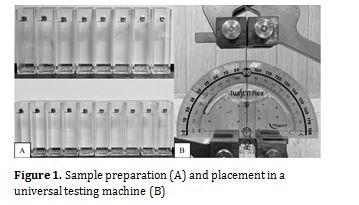
The testing procedure involved bonding of each bracket to a plastic block in a reproducible position (the intersection of two perpendicular lines precisely drawn on the cuvette using a set square) using cyanoacrylate adhesive (Loctite® Super Glue, Henkel, Germany) as shown in Figure 1A [15].
Before the adhesive dried, proper positioning of the brackets was verified using a fully engaged 0.021"×0.025" straight wire segment as a gauge, ensuring that the bracket slot and the archwire were perpendicular to the horizontal plane to prevent unwanted binding and notching according to previous studies [15, 17, 18] After bracket fixation, each bracket and archwire were sprayed with 70% ethyl to ensure a clean slot surface and archwire before testing [19]. The archwire segments were immediately ligated onto the bracket slots using elastomeric ligatures (American Orthodontics®, Sheboygan, WI, USA) by a Mathieu hemostat (Tehran Helal Industry Development Co®, Iran, Tehran) exactly before each test to minimize elastomeric module degradation [20].
The tests were performed using a universal testing machine (Z050; Zwick/Roell Company, Ulm, Germany). Each plastic block with the bracket-archwire-ligature assembly was then attached to the lower stationary part of the universal testing machine, while the free end of the archwire was fixed to the upper part. A protractor was used to ensure proper specimen alignment within the test apparatus by verifying the perpendicularity of the archwire to the horizontal plane (Figure 1B) [18]. At the start of each test, the archwire was pulled upward through the bracket slot using a 500-N tensile load cell, over a 5 mm distance at a speed of 5 mm/min [15].
Figure 1. Sample preparation (A) and placement in a universal testing machine (B)
All sample preparations were carried out by a single operator (N.F.) to ensure consistency in specimen fabrication. Similarly, all friction tests were conducted by the laboratory's designated operator to minimize inter-operator variability and enhance the reliability of the measurements.
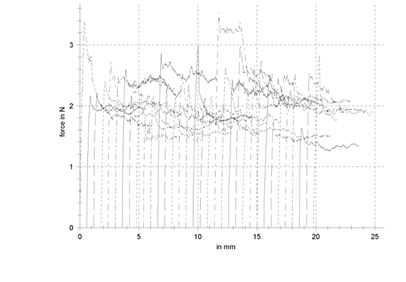
The maximum frictional force encountered during movement was recorded in Newtons (N), and a force-distance graph was plotted for each test on the monitor connected to the testing machine (Figures 2 and 3). Additionally, all the recorded forces during the movement for each test (485 data points per test) were provided in an Excel file. The mean of the recorded kinetic frictional forces during motion was calculated for each sample [15].
Figure 2. Graphs illustrating the frictional behavior of EmeraldTM brackets
The research focused on two types of orthodontic brackets including Emerald™ brackets (Tehran Helal Industry Development Co®, Iran, Tehran) and Mini Master™ brackets (American Orthodontics®, Sheboygan, WI, USA).
Given the discrete nature of the dependent variables (static and kinetic friction) and the two independent bracket groups, a type I error rate of 5% (α=0.05), and a Type II error rate of 20% (β=0.2) were set, and the study power was 80%. Based on the calculated sample size, 34 samples were required per group, resulting in a total of 68 samples [16]. The eligibility criteria included brackets with intact slots and no physical or non-standard alterations, as well as archwires free of any physical changes or bending. For this purpose, brackets and archwires were thoroughly examined under a light microscope (Carl Zeiss Meditec, Jena, Germany) at ×30 and ×40 magnifications.
For sample selection, 100 upper right canine brackets were obtained from each manufacturer (200 in total). After applying the eligibility criteria, 61 Emerald™ and 74 Mini Master™ brackets remained and were stored in separate containers labeled by brand. From each container, 34 brackets were randomly selected for the test and control groups.
Finally, 34 Emerald™ brackets (0.022" slot, MBT prescription, 0-degree torque, 8-degree angulation) were included in the study group, while 34 Mini Master™ brackets (0.022" slot, MBT prescription, -7-degree torque, 8-degree angulation) were included in the control group. Additionally, 68 straight 0.025"×0.019" stainless-steel archwires (American Orthodontics®, Sheboygan, WI, USA) with a length of 7 cm were selected after meeting the eligibility criteria.
The testing procedure involved bonding of each bracket to a plastic block in a reproducible position (the intersection of two perpendicular lines precisely drawn on the cuvette using a set square) using cyanoacrylate adhesive (Loctite® Super Glue, Henkel, Germany) as shown in Figure 1A [15].
Before the adhesive dried, proper positioning of the brackets was verified using a fully engaged 0.021"×0.025" straight wire segment as a gauge, ensuring that the bracket slot and the archwire were perpendicular to the horizontal plane to prevent unwanted binding and notching according to previous studies [15, 17, 18] After bracket fixation, each bracket and archwire were sprayed with 70% ethyl to ensure a clean slot surface and archwire before testing [19]. The archwire segments were immediately ligated onto the bracket slots using elastomeric ligatures (American Orthodontics®, Sheboygan, WI, USA) by a Mathieu hemostat (Tehran Helal Industry Development Co®, Iran, Tehran) exactly before each test to minimize elastomeric module degradation [20].
The tests were performed using a universal testing machine (Z050; Zwick/Roell Company, Ulm, Germany). Each plastic block with the bracket-archwire-ligature assembly was then attached to the lower stationary part of the universal testing machine, while the free end of the archwire was fixed to the upper part. A protractor was used to ensure proper specimen alignment within the test apparatus by verifying the perpendicularity of the archwire to the horizontal plane (Figure 1B) [18]. At the start of each test, the archwire was pulled upward through the bracket slot using a 500-N tensile load cell, over a 5 mm distance at a speed of 5 mm/min [15].
Figure 1. Sample preparation (A) and placement in a universal testing machine (B)
All sample preparations were carried out by a single operator (N.F.) to ensure consistency in specimen fabrication. Similarly, all friction tests were conducted by the laboratory's designated operator to minimize inter-operator variability and enhance the reliability of the measurements.
The maximum frictional force encountered during movement was recorded in Newtons (N), and a force-distance graph was plotted for each test on the monitor connected to the testing machine (Figures 2 and 3). Additionally, all the recorded forces during the movement for each test (485 data points per test) were provided in an Excel file. The mean of the recorded kinetic frictional forces during motion was calculated for each sample [15].
Figure 2. Graphs illustrating the frictional behavior of EmeraldTM brackets

Figure 3. Graphs illustrating the frictional behavior of Mini MasterTM brackets
Statistical analysis:
The data were entered into SPSS version 26.0 (IBM Corp., Armonk, NY, USA) for statistical analysis. Descriptive statistics, including tables, graphs, and measures of central tendency and dispersion, were used.
The normality of the data distribution was assessed by the Shapiro-Wilk test, and then the independent sample t-test was employed to compare frictional forces between the groups. A significance level of α=0.05 was set for all statistical analyses.
Results
Statistical analysis:
The data were entered into SPSS version 26.0 (IBM Corp., Armonk, NY, USA) for statistical analysis. Descriptive statistics, including tables, graphs, and measures of central tendency and dispersion, were used.
The normality of the data distribution was assessed by the Shapiro-Wilk test, and then the independent sample t-test was employed to compare frictional forces between the groups. A significance level of α=0.05 was set for all statistical analyses.
Results
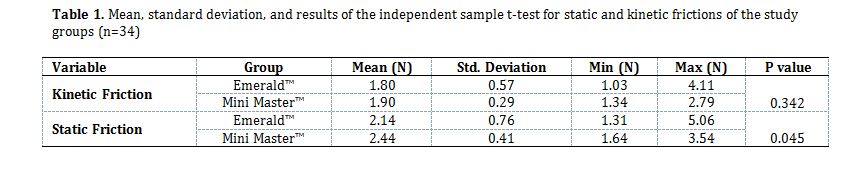
The mean and standard deviation of the kinetic and static frictional forces for the two bracket groups are presented in Newtons in Table 1.
The Shapiro-Wilk test indicated a non-normal data distribution for both kinetic friction (P=0.000) and static friction (P= 0.000) in the Emerald™ brackets. In contrast, the Mini Master™ brackets exhibited a normal distribution for kinetic friction (P=0.310) and static friction (P=0.240).
Thus, the independent samples t-test was applied to compare the frictional forces between the two bracket groups (Table 1). The results revealed a statistically significant difference in static frictional forces between Emerald™ and Mini Master™ brackets (P=0.045), indicating a higher variability in static friction values for the Emerald™ group. However, no significant difference was observed in kinetic frictional forces between the two groups (P=0.342).
The Shapiro-Wilk test indicated a non-normal data distribution for both kinetic friction (P=0.000) and static friction (P= 0.000) in the Emerald™ brackets. In contrast, the Mini Master™ brackets exhibited a normal distribution for kinetic friction (P=0.310) and static friction (P=0.240).
Thus, the independent samples t-test was applied to compare the frictional forces between the two bracket groups (Table 1). The results revealed a statistically significant difference in static frictional forces between Emerald™ and Mini Master™ brackets (P=0.045), indicating a higher variability in static friction values for the Emerald™ group. However, no significant difference was observed in kinetic frictional forces between the two groups (P=0.342).
Table 1. Mean, standard deviation, and results of the independent sample t-test for static and kinetic frictions of the study groups (n=34)
The Emerald™ group also exhibited substantial variation between the minimum and maximum friction values. For kinetic friction, the values ranged from 1.03 to 4.11 (difference of 3.08). Similarly, for static friction, the range was 1.31 to 5.06 (difference of 3.75). Comparatively, the Mini Master™ group displayed more consistent results, with a kinetic friction range of 1.34 to 2.79 (difference of 1.45) and a static friction range of 1.64 to 3.54 (difference of 1.90).
The force (friction) – distance (archwire displacement through the bracket slot) graphs are shown in Figures 2 and 3. These graphs present the test results for 34 EmeraldTM brackets (Figure 2) and 34 Mini MasterTM brackets (Figure 3). Each Figure contains 34 overlapping graphs, each graph representing the frictional force measurements for an individual bracket.
The maximum force observed at the beginning of each graph corresponds to the static friction, which is the highest force required to initiate movement. Beyond this peak, other points represent kinetic friction, which is lower than static friction in all graphs following the standard format of a friction-displacement graph [3]. Most Emerald™ brackets exhibited a similar frictional trend; however, some generated significantly higher frictional forces throughout the sliding motion, with three curves exceeding 3 N. The variation between the minimum and maximum friction values in the Emerald™ group was substantial, as shown in Figure 2.
In contrast, most Mini Master™ brackets followed a consistent frictional pattern, although two brackets displayed noticeably higher frictional forces. The Mini Master™ group exhibited more uniform results, with a narrower range of kinetic and static friction values. This trend is reflected in Figure 3, where the overlapping curves indicate less variation compared to the Emerald™ group.
Discussion
The Emerald™ group also exhibited substantial variation between the minimum and maximum friction values. For kinetic friction, the values ranged from 1.03 to 4.11 (difference of 3.08). Similarly, for static friction, the range was 1.31 to 5.06 (difference of 3.75). Comparatively, the Mini Master™ group displayed more consistent results, with a kinetic friction range of 1.34 to 2.79 (difference of 1.45) and a static friction range of 1.64 to 3.54 (difference of 1.90).
The force (friction) – distance (archwire displacement through the bracket slot) graphs are shown in Figures 2 and 3. These graphs present the test results for 34 EmeraldTM brackets (Figure 2) and 34 Mini MasterTM brackets (Figure 3). Each Figure contains 34 overlapping graphs, each graph representing the frictional force measurements for an individual bracket.
The maximum force observed at the beginning of each graph corresponds to the static friction, which is the highest force required to initiate movement. Beyond this peak, other points represent kinetic friction, which is lower than static friction in all graphs following the standard format of a friction-displacement graph [3]. Most Emerald™ brackets exhibited a similar frictional trend; however, some generated significantly higher frictional forces throughout the sliding motion, with three curves exceeding 3 N. The variation between the minimum and maximum friction values in the Emerald™ group was substantial, as shown in Figure 2.
In contrast, most Mini Master™ brackets followed a consistent frictional pattern, although two brackets displayed noticeably higher frictional forces. The Mini Master™ group exhibited more uniform results, with a narrower range of kinetic and static friction values. This trend is reflected in Figure 3, where the overlapping curves indicate less variation compared to the Emerald™ group.
Discussion
Assessing friction in orthodontic brackets is crucial, as it significantly affects treatment outcomes [19]. This in vitro experimental study aimed to determine whether Emerald™, a domestically produced bracket, could serve as a reliable cost-effective alternative to a well-established, globally recognized bracket, because using high-quality domestic products can improve treatment accessibility and affordability. To ensure a valid comparison, Mini Master™ was chosen as the reference bracket due to its similar design and material properties to Emerald™, as well as its proven accuracy and reliability in previous studies [21, 22]. Other components of the test including archwires, ligatures, and sample preparation, were also standardized between the groups.
The results showed that Emerald™ brackets had significantly lower static frictional forces compared to Mini Master™ brackets; while, kinetic frictional forces were not significantly different between the two groups. Despite the lower static frictional forces of the Emerald™ brackets, their static (1.31 – 5.06 N) and kinetic (1.03 – 4.11 N) friction values varied nearly twice as much as those of the Mini Master™ group, indicating inconsistencies in performance.
The frictional variability in Emerald™ brackets may stem from differences in bracket design and testing procedures. Although efforts were made to standardize testing and sample preparation, some variability was inevitable. Slight variations in ligature force application, bracket positioning, and surface cleanliness may have occurred and influenced the results. Additionally, previous studies on brackets suggest that variations in surface characteristics, slot dimensions, and edge finishing within standard manufacturing tolerances may have contributed to the observed differences [22-25]. Although Emerald™ brackets meet ISO 27020 standards, further research on their dimensional accuracy and surface characteristics could provide additional insights into potential sources of variability.
The findings of this in vitro study can be better understood by comparing them with previous research on frictional behavior in different testing conditions and different bracket-archwire-ligature combinations. We focused on studies examining similar components for a relevant comparison.
Monteiro et al. [18] reported mean static and kinetic friction values of 2.47 N and 1.66 N, respectively, for stainless-steel brackets with a 0.028"×0.022" slot, stainless-steel archwires measuring 0.025"×0.019", and elastomeric ligatures. Their sliding speed (3 mm/min) and archwire travel distance (2 mm) were lower than the corresponding values in the present study (5 mm/min and 5 mm, respectively). Additionally, their bracket slot size (0.028"×0.022") was larger than ours (0.022"). Despite these differences, the results were relatively similar to the present study, aligning with the findings by Ireland et al. [26], noting that friction remains relatively stable within a speed range of 0.5 – 5 mm/min.
Almashhdani et al. [17] reported a mean kinetic friction of 1.50 ± 0.50 N for stainless-steel brackets with a 0.030"×0.022" slot, stainless-steel archwires measuring 0.025"×0.019", and elastomeric ligatures, in the presence of artificial saliva. Their testing parameters were similar to ours, except for their bracket slot size and testing load cell. The lower friction values may be attributed to artificial saliva, known for its lubricating effect, consistent with the results of Baker et al.[27] who reported a 15 – 19% friction reduction with saliva.
Obaid et al. [15] reported significantly lower mean static (0.77 ± 0.23 N) and kinetic (0.78 ± 0.28 N) friction values compared to our study. Their methodology was similar, but they used nickel-free stainless-steel brackets and archwires along with artificial saliva. The lower friction values in their study may be due to the design of nickel-free brackets, which were reported to have rounded slot edges that help reduce frictional forces. Additionally, the lubricating effect of saliva, as noted by Baker et al. [27] may have further contributed to friction reduction.
In contrast, Arash et al. [28] reported significantly higher friction values than our study. These discrepancies may be due to differences in bracket-archwire materials and their higher sliding speed. Ireland et al. [26] demonstrated that sliding speeds exceeding 5 mm/min increase frictional resistance and may not accurately reflect clinical conditions. Additionally, their use of ceramic brackets likely contributed to greater friction, as Lucas [29] reported that ceramic brackets exhibit higher resistance to sliding than stainless-steel brackets. Vartolomei et al. [30] used archwire and bracket dimensions similar to our study, but their significantly higher sliding speed resulted in substantially greater frictional forces, supporting the findings by Ireland et al. [26].
The comparative analysis of the current results with those from previous literature highlights the multifactorial nature of friction in sliding mechanics. The previous studies have identified numerous variables that affect frictional resistance, including characteristics of the brackets and archwires, ligation method, sliding speed, and oral environment-related factors such as functional forces, saliva, and biofilm deposits [31, 32].
The main limitation of this study was that frictional forces were evaluated in a laboratory setting, without accounting for the effects of factors present in the oral cavity, such as saliva, chewing forces, and other functional forces. Further research is needed to evaluate the clinical performance of Emerald™ brackets and to provide clinicians with insights for optimizing treatment efficiency and quality.
Conclusion
The results showed that Emerald™ brackets had significantly lower static frictional forces compared to Mini Master™ brackets; while, kinetic frictional forces were not significantly different between the two groups. Despite the lower static frictional forces of the Emerald™ brackets, their static (1.31 – 5.06 N) and kinetic (1.03 – 4.11 N) friction values varied nearly twice as much as those of the Mini Master™ group, indicating inconsistencies in performance.
The frictional variability in Emerald™ brackets may stem from differences in bracket design and testing procedures. Although efforts were made to standardize testing and sample preparation, some variability was inevitable. Slight variations in ligature force application, bracket positioning, and surface cleanliness may have occurred and influenced the results. Additionally, previous studies on brackets suggest that variations in surface characteristics, slot dimensions, and edge finishing within standard manufacturing tolerances may have contributed to the observed differences [22-25]. Although Emerald™ brackets meet ISO 27020 standards, further research on their dimensional accuracy and surface characteristics could provide additional insights into potential sources of variability.
The findings of this in vitro study can be better understood by comparing them with previous research on frictional behavior in different testing conditions and different bracket-archwire-ligature combinations. We focused on studies examining similar components for a relevant comparison.
Monteiro et al. [18] reported mean static and kinetic friction values of 2.47 N and 1.66 N, respectively, for stainless-steel brackets with a 0.028"×0.022" slot, stainless-steel archwires measuring 0.025"×0.019", and elastomeric ligatures. Their sliding speed (3 mm/min) and archwire travel distance (2 mm) were lower than the corresponding values in the present study (5 mm/min and 5 mm, respectively). Additionally, their bracket slot size (0.028"×0.022") was larger than ours (0.022"). Despite these differences, the results were relatively similar to the present study, aligning with the findings by Ireland et al. [26], noting that friction remains relatively stable within a speed range of 0.5 – 5 mm/min.
Almashhdani et al. [17] reported a mean kinetic friction of 1.50 ± 0.50 N for stainless-steel brackets with a 0.030"×0.022" slot, stainless-steel archwires measuring 0.025"×0.019", and elastomeric ligatures, in the presence of artificial saliva. Their testing parameters were similar to ours, except for their bracket slot size and testing load cell. The lower friction values may be attributed to artificial saliva, known for its lubricating effect, consistent with the results of Baker et al.[27] who reported a 15 – 19% friction reduction with saliva.
Obaid et al. [15] reported significantly lower mean static (0.77 ± 0.23 N) and kinetic (0.78 ± 0.28 N) friction values compared to our study. Their methodology was similar, but they used nickel-free stainless-steel brackets and archwires along with artificial saliva. The lower friction values in their study may be due to the design of nickel-free brackets, which were reported to have rounded slot edges that help reduce frictional forces. Additionally, the lubricating effect of saliva, as noted by Baker et al. [27] may have further contributed to friction reduction.
In contrast, Arash et al. [28] reported significantly higher friction values than our study. These discrepancies may be due to differences in bracket-archwire materials and their higher sliding speed. Ireland et al. [26] demonstrated that sliding speeds exceeding 5 mm/min increase frictional resistance and may not accurately reflect clinical conditions. Additionally, their use of ceramic brackets likely contributed to greater friction, as Lucas [29] reported that ceramic brackets exhibit higher resistance to sliding than stainless-steel brackets. Vartolomei et al. [30] used archwire and bracket dimensions similar to our study, but their significantly higher sliding speed resulted in substantially greater frictional forces, supporting the findings by Ireland et al. [26].
The comparative analysis of the current results with those from previous literature highlights the multifactorial nature of friction in sliding mechanics. The previous studies have identified numerous variables that affect frictional resistance, including characteristics of the brackets and archwires, ligation method, sliding speed, and oral environment-related factors such as functional forces, saliva, and biofilm deposits [31, 32].
The main limitation of this study was that frictional forces were evaluated in a laboratory setting, without accounting for the effects of factors present in the oral cavity, such as saliva, chewing forces, and other functional forces. Further research is needed to evaluate the clinical performance of Emerald™ brackets and to provide clinicians with insights for optimizing treatment efficiency and quality.
Conclusion
The results of this in vitro study showed that static friction was consistently higher than kinetic friction in all samples, following the expected friction pattern during movement. Although kinetic friction did not differ significantly between the two bracket groups, static friction was significantly lower in the Emerald™ group. However, the Emerald™ group exhibited a broader range of friction values compared to the more uniform distribution in the Mini Master™ group, suggesting variability in performance. These findings suggest that Emerald™ brackets may serve as a low-friction option; however, further research is required to assess the clinical impact of their variability.
Acknowledgments
Acknowledgments
We sincerely appreciate Tehran Helal Industry Development Co® for funding this project. Additionally, we would like to express our gratitude to the Dental Materials Laboratory at Shahid Beheshti University of Medical Sciences for providing the light microscope and sample preparation facilities, and to the Dental Materials Laboratory at Tehran University of Medical Sciences for providing access to the universal testing machine.
Conflict of Interests
Conflict of Interests
The authors declare no personal financial interests or conflicts of interest related to this research. The funding organization had no role in the study design, data collection, analysis, interpretation, or manuscript preparation.
Type of Study: Original article |
Subject:
orthodontic
References
1. Liu F, Wang Y, Luopei D, Qu X, Liu L. Comparison of fixed braces and clear braces for malocclusion treatment. BMC Oral Health. 2024 Aug 14;24(1):941. [DOI:10.1186/s12903-024-04469-2] [PMID] []
2. Mundhada VV, Jadhav VV, Reche A. A Review on Orthodontic Brackets and Their Application in Clinical Orthodontics. Cureus. 2023 Oct 7;15(10):e46615. [DOI:10.7759/cureus.46615]
3. Kamel HA, Taha SS. Frictional Resistance in Orthodontics-A Review. (Humanities, social and applied sciences) Misan Journal of Academic Studies. 2023 Dec 30;22(48):253-63. [DOI:10.54633/2333-022-048-019]
4. V S B, Kaul A, Tiwari A, Aliya S, Yadav A, Bera T, et al. Assessment of Various Archwire Materials and Their Impact on Orthodontic Treatment Outcomes. Cureus. 2024 Sep 18;16(9):e69667. [DOI:10.7759/cureus.69667]
5. Chatuan M, Elguennouni B, Halimi A, Zaoui F. Canine retraction with nickel-titanium coil springs versus elastomeric chains: A systematic review. Journal of Dental Materials & Techniques. 2024 Sep 1;13(3)..
6. Umićević-Davidović M, Arapović-Savić M, Arbutina A, Adamović T, Kuzmanović-Radman I. Analysis of sliding mechanics force degradation during postextraction space closure. Stomatoloski glasnik Srbije. 2022;69(3):115-24. [DOI:10.2298/SGS2203115U]
7. Ribeiro GL, Jacob HB. Understanding the basis of space closure in Orthodontics for a more efficient orthodontic treatment. Dental Press J Orthod. 2016 Mar-Apr;21(2):115-25. [DOI:10.1590/2177-6709.21.2.115-125.sar] [PMID] []
8. Mote N, Dhanjani V, Das S, Pallan K. Governing the Friction in Fixed Orthodontic Appliance. Iranian Journal of Orthodontics. 2019 Sep 1;14(2):1-6. [DOI:10.5812/ijo.103731]
9. Prasetyadi T, Irawan B, Purwanegara MK, Suharno B, Supriadi S. Orthodontic Bracket Friction Affected by Design Selection Material and Manufacturing Process. Applied Mechanics and Materials. 2022 Nov 21;910:39-44. [DOI:10.4028/p-kfmno4]
10. Kusy RP, Whitley JQ. Frictional resistances of metal-lined ceramic brackets versus conventional stainless steel brackets and development of 3-D friction maps. Angle Orthod. 2001 Oct;71(5):364-74.
11. Li Y, Zhan Q, Bao M, Yi J, Li Y. Biomechanical and biological responses of periodontium in orthodontic tooth movement: up-date in a new decade. Int J Oral Sci. 2021 Jun 28;13(1):20. [DOI:10.1038/s41368-021-00125-5] [PMID] []
12. Viglianisi G, Polizzi A, Lombardi T, Amato M, Grippaudo C, Isola G. Biomechanical and Biological Multidisciplinary Strategies in the Orthodontic Treatment of Patients with Periodontal Diseases: A Review of the Literature. Bioengineering (Basel). 2025 Jan 9;12(1):49. [DOI:10.3390/bioengineering12010049] [PMID] []
13. Dragomirescu AO, Bencze MA, Vasilache A, Teodorescu E, Albu CC, Popoviciu NO, et al. Reducing Friction in Orthodontic Brackets: A Matter of Material or Type of Ligation Selection? In-Vitro Comparative Study. Materials (Basel). 2022 Apr 3;15(7):2640. [DOI:10.3390/ma15072640] [PMID] []
14. Lo Giudice A, Portelli M, Militi A, Spinuzza P, Bellocchio AM, Nucera R, et al. Is static friction affected by aging and amount of elastomeric ligatures in orthodontic sliding mechanics? An in-vitro investigation. J Biol Regul Homeost Agents. 2018 Mar-Apr;32(2 Suppl. 2):67-73.
15. Obaid DH, Al-Dabagh DJ, Jasim ES. Assessment of friction among nickel free orthodontic brackets and archwires combinations in wet condition (an in-vitro comparative study). J Res Med Dent Sci. 2020 Nov;8(7):387-93.
16. Shah P, Sharma P, Naik H, Patel K, Panchal C. A comparative evaluation of frictional resistance and surface roughness of silver coated and uncoated stainless-steel bracket wire assembly- An in-vitro study. J Clin Exp Dent. 2023 May 1;15(5):e411-e419. [DOI:10.4317/jced.60357] [PMID] []
17. Almashhdani MI, AlSamak S, Hamood MA. Comparison of friction generated on conventional and coated stainless steel archwires during sliding mechanics using monocrystalline ceramic bracket and stainless steel bracket. AMJ. 2023;63(02):7861-69.
18. Monteiro MR, Silva LE, Elias CN, Vilella Ode V. Frictional resistance of self-ligating versus conventional brackets in different bracket-archwire-angle combinations. J Appl Oral Sci. 2014 Jun;22(3):228-34. [DOI:10.1590/1678-775720130665] [PMID] []
19. Siddiqui S, Wani MA, Koul R, Yadav V, Rozy F, Battoo MR. Evaluation of the frictional resistance between different bracket types, archwires and ligation materials: An in-vitro study. International Dental Journal of Students' Research. 2023 Jan 1;11(1). [DOI:10.18231/j.idjsr.2023.004]
20. Ebrahimi P, Nastarin P, Hadilou M, Karimzadeh B, Kachoei M. Effect of Elastomeric Module Degradation and Ligation Methods on Kinetic Friction between NiTi or Stainless Steel Wires and Stainless Steel Brackets. Front Dent. 2024 Mar 14;21:10. [DOI:10.18502/fid.v21i10.15222] [PMID] []
21. Pugalendhi R, Varma NKS, Ghosh P, Ajith VV, Nair DJ. Effect of Chlorhexidine and Povidone-iodine Mouth Rinses on Corrosion Resistance and Surface Characteristics of Stainless Steel Orthodontic Brackets - An in vitro and in vivo Study. Contemp Clin Dent. 2024 Jul-Sep;15(3):149-57. [DOI:10.4103/ccd.ccd_433_23] [PMID] []
22. Divya P, Banswada SR, Kukunuru SR, Kavya KB, Rathod RR, Polavarapu KC. To Compare the Accuracy of 0.022 Inch Slot of Stainless Steel and Ceramic Orthodontic Brackets Marketed by Different Manufacturers. J Pharm Bioallied Sci. 2021 Nov;13(Suppl 2):S1037-S1041. [DOI:10.4103/jpbs.jpbs_295_21] [PMID] []
23. Kolhe SA, Patani S, Daokar S, Kumar T, Pawar RA, Dhope SV. Evaluation of dimensional accuracy and surface roughness of lingual bracket slot -An in vitro study. IJODR. 2024;10(3):208-14. [DOI:10.18231/j.ijodr.2024.037]
24. Bernes Martinez L, Garcovich D, Alvarado Lorenzo A, Zhou Wu A, Aiuto R, Adobes Martin M. Tip and Torque Accuracy According to the ISO 27020: 2019 Norm in Currently Available Pre-Adjusted Orthodontic Brackets. Applied Sciences. 2021 Dec 8;11(24):11657. [DOI:10.3390/app112411657]
25. Bernés Martínez L, Garcovich D, España Pamplona P, Adobes Martín MA, Alvarado Lorenzo A. Compliance with the ISO 27020: 2019 norm of a sample of currently available preadjusted Orthodontic bracket systems. Are the actual dimensions as expected?. Head & Face Medicine. 2021 Dec;17:1-0. [DOI:10.1186/s13005-021-00276-0] [PMID] []
26. Ireland AJ, Sherriff M, McDonald F. Effect of bracket and wire composition on frictional forces. The European Journal of Orthodontics. 1991 Aug 1;13(4):322-8. [DOI:10.1093/ejo/13.4.322] [PMID]
27. Baker KL, Nieberg LG, Weimer AD, Hanna M. Frictional changes in force values caused by saliva substitution. Am J Orthod Dentofacial Orthop. 1987 Apr;91(4):316-20. [DOI:10.1016/0889-5406(87)90173-9] [PMID]
28. Arash V, Rabiee M, Rakhshan V, Khorasani S, Sobouti F. In vitro evaluation of frictional forces of two ceramic orthodontic brackets versus a stainless steel bracket in combination with two types of archwires. J Orthod Sci. 2015 Apr-Jun;4(2):42-6. [DOI:10.4103/2278-0203.156028] [PMID] []
29. Lucas J. Comparison of Resistance to Sliding of Three Different Bracket Systems After Various Sliding Distances (Master's thesis, Nova Southeastern University).
30. Vartolomei AC, Serbanoiu DC, Ghiga DV, Moldovan M, Cuc S, Pollmann MCF, et al. Comparative Evaluation of Two Bracket Systems' Kinetic Friction: Conventional and Self-Ligating. Materials (Basel). 2022 Jun 17;15(12):4304. [DOI:10.3390/ma15124304] [PMID] []
31. Selvaraj M, Mohaideen K, Sennimalai K, Gothankar GS, Arora G. Effect of oral environment on contemporary orthodontic materials and its clinical implications. J Orthod Sci. 2023 Mar 18;12:1. [DOI:10.4103/jos.jos_73_22] [PMID] []
32. Cury SE, Aliaga-Del Castillo A, Pinzan A, Sakoda KL, Bellini-Pereira SA, Janson G. Orthodontic brackets friction changes after clinical use: A systematic review. J Clin Exp Dent. 2019 May 1;11(5):e482-e490. [DOI:10.4317/jced.55676] [PMID] []
Send email to the article author
| Rights and permissions | |
 |
This work is licensed under a Creative Commons Attribution-NonCommercial 4.0 International License. |